Showing posts with label Philosophy. Show all posts

Sunday, February 20, 2011

Save our forests update

Well as usual I got stuck on the Tony Baldry specific issue mailing list. Tony stuck to his guns saying that privatisation of the forests was the right thing to do, even sending me an email debunking the 10 myths spread about by the press. One day later the Secretary of State cancelled the sell off.

Funny isn't it how someone can be so adamant that privatisation is so right and then have to flip there position because their leader do so. At least I assume Tony will now say that he is listening to the will of the people and joining with David Cameron to support the public in keeping the forest in public hands. He hasn't yet sent me an email telling me this but I am sure this is his new view.

One of the big issues I have with party politics is that it prevents individuals doing what they think is right or having independent thought. If Tony disagrees with David then fine, please come back to me and say that you still support privatisation of the forests. At the moment I suspect that you only follow the party line and I have no real evidence that you truly stand up for what you believe in,

As a voter I want to know you are voting with your head and heart on behalf of your constituents not just being a loyal supporter of David.

Anyway the next issue coming up is Alternative Voting (AV) - the transferable vote. Watch this space. I am leaning towards the "Yes" camp but I do want to explore the issues fully first.

Wednesday, October 20, 2010

The Spending Review: A Personal Response

I am a public sector worker, I am not on the coalface but I hire the people that work on the coalface. I agree that cuts had to be made and they had to be deep. I agree that they had to cut the Public Sector borrowing requirement down to size but not eradicate it.

However, I have no doubt that the coalition has gone farther than it needed to, due to the Conservative ideology of smaller government.

I do believe that we needed to make an across the board cut of at least 10%. I don't believe any area should have been ring-fenced including however unpalatable the NHS and education. It is time to live within our means. A significant amount can be saved in the public sector through efficiency saving and getting rid of "nice-to-have" services that have built up in the last ten years without affecting core services. 10% is I believe a fair line in the sand.

I think the public sector pay freeze is right even though in real terms it means many poorly paid workers will find it much harder. Again given the extreme circumstances we find ourselves in I feel a pay freeze is preferable to loosing more jobs.

I think any additional spending should be frozen, what we don't have now we no longer need. A lot of commentators have compared the deficit to your own debt, when you have a debt you need to reduce it. I would compare the budget requirements to a household budget, when money is tight you don't spend it on new things or reduce spending on food to move to a bigger house. You make do with what you have got and so it is time to make do with what we have got. When the good times come again then we can look for new opportunities.

I would not reduce corporation tax, big business got us into this mess they can help us out of it. The argument that this is to stimulate growth is valid but public sector spending and public sectors workers also contribute to the economy.

I would not increase International development, again referring to the household budget, I like to give to charity but I don't give more than I can afford. As a country we may have a responsibility to the rest of the world and that is why I would not make any reduction in the budget for international development but it would be frozen.

I would not give a rise to the cabinet office for their "big society" work. "Big society" is a good idea but it doesn't not need that much money. I would prime the pump but not to the extent of £1.8 bn perhaps £0.5 bn would be more appropriate. Government cannot order you to volunteer but they can encourage you.

I would bring forward the pension age increase, it makes economic sense.

I would increase pension contributions, although I acknowledge it will be painful the current system is no longer viable for individuals, the country or the economy.

I would not freeze the science budget but as per all other areas cut it by the required 10%. Sorry scientists everyone needs to do more with less and no one can be protected under these circumstances.

I would get rid of trident, we have no need for a nuclear deterrent that we would never use saving us £20 bn that could be better spent elsewhere.

With some significant regret I would not expand the funding for energy and climate change projects. Again we cannot afford the "nice to do" stuff, when things improve they can go back on the agenda. For now the £2.9bn could be better spent elsewhere. I would if the figures allowed allocate £200m for the wind power projects and £50m for solar power and energy efficiency projects. This would help continue the push to a green and sustainable economy. In this area alone I feel we must move forward not back.

I would not scrap the index linking for rail travel, those without cars would be the hardest hit.

The NHS is tricky but I would enforce my golden rule of 10% cuts with a stipulation that savings must be made from efficiency saving and cutting red tape and not closing wards or hospitals. That may be very painful but I would also commit that when the good times come back the NHS would be the first in the queue and I would aim for funding increases to a level equivalent of 5% per year for each year they received no increase. Over the long term there would be no reduction in funding.

There are other areas I could go into but I think you can understand extrapolate my thoughts.

On one final note the average savings across the board for the government have been 19%. I have said across the board saving will be 10% with some significant extra savings made which should allow us to head towards the 19% target. In addition, I do not believe we need to totally eradicate the deficit. Some deficit is acceptable as long as it continues to reduce and does not get out of hand.

I recommend my plan to the house.

Friday, September 24, 2010

To leak or not to leak: 5 types of leaker

Another day, another leak. Goes nicely with cheese don't you know.On a more serious note who is behind a leak and what are their motivations.

First, I suppose is the "knight leaker". They do it because the public should know about this travesty / abomination, they are people of honour and integrity, a shining example to us all. I imagine them to be people who have campaigned internally for the information to be released and get frustrated enough, realise it will never come to light unless they take a stand and do it themselves. I imagine these people have true moral dilemmas over loyalty and accepting what the right thing to do is. I imagine the decision to leak wins over loyalty on the basis it is for the good of mankind.

An example of this type of leak is that a government department has failed to keep track of 50,000 immigrants and has not put in place any policy to resolve the issue. Or Revenues and Customers have notice 50,000 tax errors but are only chasing those that have underpaid.

Then there must be the "profit leaker", they have information that someone wants and is willing to pay catch for it. Psychologically they think they can easily get away with it or the profit outweighs the risk. They have no moral dilemmas and are motivated by pure hard cash which might get them a new car or a house in the country. They also think there is no victim and it is perfectly harmless.

These people might be giving away confidential information such as who has quoted what for a government tender or giving away personal details such as bank details they might have access to.

Next will be the "thrill seeker leaker", this small group purely like being the centre of attention, they might be the secretary's and assistant's who are underpaid and over worked. Yet now they control the information and can leak something important. Again they think it is harmless, at least at first, then they might display addictive tendencies, aching for just one more leak. They probably carry on until they get caught or just get too greedy and leak something too big to go unnoticed.

Then there is the "revenge leaker" these have information which put someone in a bad light. They can also twist the information to be out of context, perhaps by lifting quotes which in isolation look bad. This is a very politically motivated leak and might be to discredit a rival. I imagine there are some labour supporters in government departments who pass things to Labour so the Tories look bad.

Finally, there is the "false leaker", these are the government sponsored leaks to test public opinion. I would imagine 50% of leaks at least, have semi official approval because if they leak the document they can canvas public opinion for free and if there is unanimous disapproval of a leak the party involved can always go on record and say it was a "blue sky" discussion document that was drafted and circulated at a low level. The document was never meant for public consumption and was discarded at an early stage. Most importantly the government or other party has plausible deniability.

As a way to canvas public opinion for free you cant really fault it.

I think today's announcement is of the false leak variety. The government can canvas opinion and see how much support some of these bodies or organisations have. If the hordes start to advance on Downing street they can always deny there was ever any intention to abolish the organisations. Plausible deniability and smoke and mirrors, now its policy now its not.

Thursday, July 23, 2009

State of Fear by Michael Crichton

I re-read this book recently, it is a work of fiction which introduces the premise / theory that the environmental lobby is just another method by the establishment to keep us in a perpetual state of fear, following on from the cold war came global warming. This state of fear creates spending and political power but the book using scientific references to support the fictional plot suggests that global warming is at best inconclusive and suggests that we are yet to learn so much about are environment that any theory about global warming is little more than a guess.

However as the character in the book suggests just because you don't agree with global warming doesn't mean that you don't want pollution controls and CO2 reduction. I have to say Michael Crichton creates a compelling argument. One of the best simple comparisons is that despite all the investment and technology we cannot accurately predict the weather beyond 5-10 days so how can we consider a prediction for a 100 years hence to be accurate.

There are loads of other rational arguments in the book but with the alternative view I find it difficult to believe that global warming is a global conspiracy. I suppose one of the problems is that until it happens we wont know whether everyone is right or wrong.

The precautionary principle also mentioned in the book means that if there is the slightest change of the catastrophic scenario occurring then we should not take the action that would cause it. Therefore the precautionary principle would suggest that because scientists have found a potential risk we should do everything to eliminate it. However you could use the precautionary principle to say we should live 50 ft underground all the time because every time you go outside there is a risk of a plane falling on your head.

Then I reach the thought in my head that says "Do I believe in global warming?". Then my second thoughts kicks in and realises the framing of the question suggests there is a belief factor rather than relying on cold, hard, undeniable facts and truths.

"Do I believe in doing something to protect the environment?". No facts required this time but how do you protect an environment, again it raises in the book that you can only manage an environment and we still don't know how to manage land to protect something. The ecosystems around us are ever changing we cant protect and preserve but we can manage it in a direction. In the books it talks about nature not having a balance but oscillating between different factors as species rise and fall.

Finally the book finishes with the premise that they should set up a new environmental group which basically looks for problems and fixes it, so take land management, you accept you do not know how to do it, so you take 8 similar parcels of land, have a different management policy in each one. Try things out get them evaluated by outside consultants and by trial and error find out what land management policies work and don't work.

One character talks about scientific journal authors talking about simulations as if they were real world data and suggest that such articles should be labelled "Warning: Computer Simulation - May be erroneous and unverifiable" and then suggests a label for newspaper articles as well "Warning speculation - may be fact free".

I have long argued about labels for news articles, some kind of evaluation of the source:

How about this the Zephryist- Morton coding
(the highest number would be taken in each code)

8 - Video evidence
7 - Sound evidence
6 - Multiple eye witness accounts
5 - conflicting eye witness accounts with some commonality
4 - Single eye witness account
3 - written evidence
2 - Multiple eye witness conflicting accounts
1 - 2nd hand source no eye witness accounts
0 - opinion only no verifiable witness 1 or second hand

4 - Known as giving previously reliable evidence
3 - No previous record of evidence
2 - Questionable record of giving reliable evidence
1 - interpretation of known facts with own opinion on conclusions or extrapolation
0 - own opinion - few known facts with open interpretation.

3 - Expert / professional in field
2 - Media expert in field
1 - Amateur in field
0 - Unknown knowledge status in field.

So with this you could evaluate any news source such as the BBC news website which would be a 8 by 4 by 2 site, one of the highest rating with video evidence, known to give reliable evidence in the past, and with media experts.

You could also rate a blog, my highest rating would be a 4 by 4 by 1 unless you felt I was merely giving opinion where my blog would be rated 4 by 1 by 1. Of course with a fully functioning system the ratings would be given by peers.

The beauty of the system is that the lower the number the more questionable the source, it would help any reader instantly be able to separate fact from fiction without having to read pages of previous articles and compare them with other sources to determine the reliability, with a peer reviewed system other people have already done the leg work.

You could go further and break down the rating system more by breaking each section into a series of questions almost an acid test of reliability.

I may return to this some day or like many other posts on my blog it may just be a random thought that sits on the shelf collecting dust.

Wednesday, April 22, 2009

Earth Day - 22 April


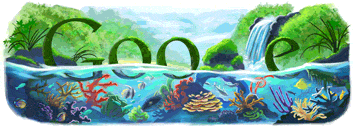
Today April 22 is Earth Day and in the usual way I find out about these things it was because Google has redesigned their logo for the day.
According to wikipedia earth day is a day to inspire awareness and appreciation for the earth's environment. First observed in 1970 now it hardly breaks the news (at least round here, except google of course).

So lets take a second and think of something beautiful in our environment that we might want to protect for future generations.

For me the humble cherry tree and the humble bumble bee, two things that are natures marvels and without protection, life would be a little bit less bearable. I for one would not want to be old telling my grandchildren that in my youth we had cherry trees with blossom just like confetti and we had bees that went buzz and made honey. If that future comes to pass, as an old man I could not bear to speak of what precious things we took for granted and lost on the tarmac path to progress. In my old age I want to sit under the cherry tree letting the blossom fall against my wrinkled skin as the bees buzz round the granchildren and me. I would want to reflect on the sea change in the first few years of the 21st century that lead to sustainable growth policies which worked in harmony with nature.

Tuesday, November 11, 2008

The end of the world as we know it..

OK may be not quite the end of the world but the end intellectual debate and the dumbing down of the English language.

I am designing some new assessment materials at work based around communication skills, part of the folio is some group discussions. These group discussions have now gone out to consultation with our partner groups and I am collating the feedback.

One topic included the world "eradicate", one comment has suggested that we use the word "remove" instead, as people may not understand the word "eradicate".

I am all in favour of not over complicating things, I started nodding and thinking what a good piece of advice that was. Then I had one of those record screeching moments where the needle is taken off the record scratchily (that reference probably lost 90% of the audience but I shall struggle on, if you are not sure what a record is try wikipedia). If someone doesn't know a word it is not cruel or unfair to use it or a reason for me to change it, that is a reason for someone to pick up a dictionary or use the internet to look up the meaning.

To me the two words have distinctly different meanings so I feel it is important to use eradicate. The English language is currently rich with many great words for all occassions, we should not reduce it to a language where there is only one word for everything. What next, get rid of blue and call it light black, where do we stop, eradicate is a good word and I say it stays.

"Say no to the eradication of eradication"
My point is that everyone, if they dont know something should take the opportunity to learn and look it up. It should never be that if people dont know something its the other persons fault for not using the right word. Individuals need to take responsibility, develop themselves and protect the richness of the english language.

Another comment was that I cant use a discussion topic about insurance because some people might not understand the concept. Well if they dont that should form part of the discussion and if they dont, why dont they? Insurance is virtually fundamental to several aspects of life and surely it is a fairly simple concept. Even if you cant explain how insurance works you know about premiums, claims and have a vague knowledge of risk. Again we shouldnt avoid discussing things because people might not know, the things people don't know are the exact things we should be discussing. Humanities job is to learn and develop, there is nothing wrong with ignorance if you do something about it, if you ignore it and hope it goes away then the only person you are failing is yourself.

End of moan, join me next week when I tell you about the new course I have been on, "Effective moaning for professionals". Apparently it even comes with roleplays.

Thursday, October 23, 2008

I have been thinking...

I have been thinking about one thing that will change the world. I have a spare £1 in my pocket and know that there are 60 million other people in the UK that have a spare £1.

Effectively then I have £60 million to make a small change to make the world a better place. I have £60 million because while some will give none a lot of people will give more.

So one small gesture to create a big gesture, to change the world.

If you expand that premise to the world there are 6.7 billion people so £6.7 billion to make an even bigger gesture.

The question is what could you invest £6.7 billion in, to really fundamentally change the world for the better for everyone.

£1 to change the world 6 billion reasons to do it.

Notes:

There is a part of me that wants to write in a post ironic modernism type of way after the above article "Zephyrist Aged 10 and a half". There is a certain idealistic naivety to the article that the entire population of the world could unite to make one change when often charities struggle to get just a few people to donate money.

There is another part of me that says the only people that have ever changed the world are the idealistic dreamers. They dare to dream the impossible, somehow and no one quite knows how, it becomes possible.

Leadership is about creating new realities, drawing people in and breaking down barriers. Great leaders dream both the dream and of how to make it a reality.

One thing I do know is that if you never think of something or never say it out loud you have strangled the dream at birth.

The ten and a half reference harks back to childhood where nothing is impossible, all the bad things don't exist and we can do anything if only we set our minds to it. Growing up is about finding out there are barriers whether in skill or talent or just what seems like luck. However much we want something sometimes it just wont happen.

At times like that it is easier to get cynical and look negatively at things. There is no point applying for that job, I wont even get an interview and they are probably not looking for someone like me. However, if you don't try, how do you really know you will fail. Even if you cant imagine the possibilities, all of them are out there.

Maybe I can't change the world all by myself but maybe if I keep generating ideas someone will pop along, pick it up and run with it.

Our only limitations are the limitations we impose on ourselves.

Monday, February 18, 2008

Ladders, Appraisals and funerals

Ladders

On my way to work this morning there was a ladder leant across the pavement against a wall. Rather than walk under the ladder I walked into the road and around it.

I would not class myself as superstitious although my previous paragraph would contradict me. I believe I'm just not someone that risks looking for trouble. There is enough to worry about in life than going looking for something extra. After all maybe the superstition about ladders is due to the number of things that drop on peoples heads as they go under the ladder.

As far as I can see best to minimise the risks and not take the chance.

Appraisals

Yes, its that time of year again when I write the work of fiction entitled "What I did at work this year". The annual appraisal is upon me again. The workplace is alive with works of fiction that could outsell some of the latest paperback novels.

Appraisals the system that was bought in to replace favouritism by bosses, so now the good writers among us can make up rubbish have it signed off by the same boss, but not there couldn't possibly be any favouritism, performance is all evidenced in the appraisal.

If you believe that, can I interest the emperor in a new pair of trousers. Cloth so fine you can barely see it (OK you cant mainly because it doesn't exist).

The reason I loathe the appraisal system is because linking it to performance pay they give everyone the dream that they could get a better pay rise than everyone else. In reality 90% of us get exactly the same pay rise but to compound it all you get the same grade as someone who barely turns up to work and everyone complains about. Whilst you beaver away getting the job done and enjoy moderate success.

Even worse about the appraisal at our organisation is that it has been refined to such management speak terms that no normal person can understand it but if you dare criticise the system you are an enemy of the organisation and clearly not a team player.

I call it the more cheese system, I turn up to work, complete my appraisal and press the button for more cheese. The system sees that I have pressed the button and rewards me with a small piece of cheese. Lucky me I am a fully trained organisational rat.

I have only two ways of subverting the system:

1) make the whole process hell for my manager, whine, moan, complain and drop in quotes about more cheese. This works quite well, although clearly I have to forfeit any chance of getting a superb grading in my appraisal although to be fair the chances of getting anyway was non existent.

2) After the appraisal has been signed off and the rating signed off there is a final comments box where I am allowed to put anything I want. (insert evil laugh here)

This year I am thinking a quote, maybe something by Ray Bradbury:

"There was always a minority afraid of something, and a great majority afraid of the dark, afraid of the future, afraid of the past, afraid of the present, afraid of themselves and shadows of themselves."

"If they give you ruled paper, write the other way."

I will chose between the two although the second quote from Fahrenheit 451 appeals to my sense of humour.

Funerals

The talk at work a while back was of funerals, the bit that stuck in my mind was about the choice of music. Its not something we like to think about but occasionally such talk leads us to wonder what we would like. These days pretty much anything goes from traditional hymns to rock ballads.

I would like a mixture of both. I would like to start with the hymn "For those in peril on the sea", I love the coast, never liked being on the sea, cant really swim much but its a good tune. Other hymns might include "Abide with me", "Guide me o though great redeemer" or if near Christmas I could quite go for an ironic sing along of "God rest ye merry gentleman".

If we are going modern I quite like rooftops by lost prophets preferably at architecture wobbling volume with massive bass bins.

"When our time is up,When our lives are done,
Will we say we've had our fun?

Will we make a mark,
This time.
Will we always say we tried. "
...
"All the love I've met,
I have no regrets,
If it all ends now,
I'm set."
...
"Standing on the rooftop,
Waiting till the bomb drops,
This is all we've got now,
Scream until your heart stops,
Never gonna regret,
Watching every sunset,
Listen to your heartbeat,
All the love that we've felt."
...
That would be a good sentiment to end on,

"When our time is up, When our lives are done, Will we say we've had our fun?"

Saturday, November 24, 2007

Friday's Work day prayer

While trudging to work at the end of a long week I was thinking of a prayer to get me through the day. Don't worry I am not about to get all religious on you I was remembering some joke prayer about asking for the strength to get through the day despite all the idiots or something like that.

A bit of google work later... there are a few versions of a joke email that gets forwarded everywhere which is in turn a corrupted version of a famous prayer called 'The Serenity Prayer'.

The Joke Version:

Grant me the serenity to accept the things I cannot change,
The courage to change the things I cannot accept,
And the wisdom to hide the bodies of those people
I had to kill today because they pissed me off.
You can see how apt this is when you are facing another day at the organisation where the phrase 'bureaucracy gone mad' was invented.

The Original Version:
God grant me the serenity
to accept the things I cannot change;
courage to change the things I can;
and wisdom to know the difference.
--Reinhold Niebuhr
The second version is a nice little prayer even if you don't believe in God.

This all got me to thinking that really in the poem the word god could be replaced by something like " God, any other religious deity, any being or anything that has the power to help me".

In my simple thoughts of religious matters I ponder whether belief in a god is necessary for a prayer to take place. After all a prayer could be described as asking for something where the outcome is not certain. After all if a close relative is dying we still will them to survive even if we do not start our thoughts with "Dear God".

Which made me think of a thought experiment about whether atheists pray. If a person had for whatever reason jumped out of a plane without a parachute and was plummeting to the ground with about four minutes to live what would they be thinking. Well you would be thinking I hope something happens to save me which in a sense is a prayer. Proof positive.

Of course testing this would require speaking to people who are falling to their impending death. Given that most people don't willingly jump out of a plane without a parachute this could be a bit difficult.

All those thoughts because of another tedious Friday.

Note: If this article has caused any offence to anyone, this was not my intention. It was merely a random thought from my brain.

Monday, October 29, 2007

The Roy G. Biv theory

This is one of those half baked ideas that I have.

I cant decide whether this idea is:

a multi million pound paper back book Christmas special finally giving ordinary people the key to live a happy, successful life...

Or...

a parody of the million pound paper book back... blah blah blah etc etc etc...

Or...

a collection of odds and sods reorganised into something that is completely worthless...

Or...

just an interesting coffee break thought.

For those of you that don't know 'ROY G BIV' represents the colour and order of a rainbow (although according to wikipedia there may be some argument about this).

R - Red
O - Orange
Y - Yellow

G - Green

B - Blue
I - Indigo
V - Violet

Now inspiration particles (Terry Pratchett reference) hit in completely random places, this one hit me on a bus on the way to work in bright sunshine on a late October day. It was inspired by the following musical lyric.

"...And it was all yellow... "
-Yellow, Coldplay

So anyway on to the theory.

The Roy G. Biv Theory

Take any day and assign it a colour from 'ROY G BIV' according to the following colours and meanings.

Red -

Red is for passion, not just love but any day when you are passionate about something. It can be a thirst for making a change in your life or passionately arguing to change somebodies mind. It does not representative destructive anger or negative argumentative passion.

A red day is a positive day.

Orange -

Orange is about ideas and creativity. Orange screams listen or look at me. Orange are for those days where your energy and creativity are strongest. You mind solves intricate problems with ease.

An orange is a positive day.

Yellow -

Yellow is sunshine, happiness and contentment. Yellow is about being at ease with yourself and enjoying your day. Maybe nothing special happens but a yellow day is a pleasant emotionally stable day.

A yellow day is a positive day.

Green -

Green is the colour of change. Green is about changing not necessarily for the better. Green days are tough days that take a lot of energy and concentration potentially for little reward.

A green day is a neutral day.

Blue -

Blue is the colour of sadness. It can be a very emotional time, negative often associated with depression or tears. Blue days are emotionally draining days where you would rather be wrapped up under the duvet shutting yourself off from the world.

A blue day is a negative day.

Indigo -

Indigo is the colour of spiritualism. It is about deep thought sometimes with a detachment from reality. Indigo days are characterized by a feeling of not being a part of the every day world. A day of being lost in your own world.

An indigo day is a neutral day.

Violet -

Violet is the colour of anger. It is about anger barely contained, an explosion waiting to happen. Violet days are characterized by a general grumpy feeling, a tense day where you could lash out at anyone and everyone.

A violet day is a negative day.

Now do this for a week taking the predominant colour of each day and you will have a list like so

Colour
RRGBOYII

+/-
++ . - + + .. giving a total score for the week of +3.

Obviously the more positive your week the better, and for negative weeks you can look closely at your problem areas.

As the weeks go by you will start to see patterns to the days and emotions which will enrich your understanding of yourself.

This framework is about starting a voyage of discovery about you and your emotions and how that ebbs and flows over a week.

...End of theory...

Now,do you see the problem I had at the start of this article. On a very superficial level my theory seems as good as any other mumbo jumbo that makes it into the paperback Christmas chart but when you look a bit close isn't all just a load of made up nonsense.

All the colours are an adaption or reorganisation of existing colour theory or just what the colour sometimes means to me.

Either way I am going to park it here on my blog, make of it what you will.

Just in case, if it does turn out that the idea is worth millions, please note the copyright and intellectual property contained here in belongs to me, and I will sue.

Monday, September 17, 2007

Speeches that changed the world

I have seen this book around and it spoke to me as a book that should really be in my collection. After all like most people I am aware of great speeches like the Gettysburg address or the 'I have a dream speech' but I have never actually read them. Plus I am fascinated by such things so when a book token came into my hands I went to get the book.

The speeches have been chosen because of their impact on the world. Some were made by great men, some by evil men and other were made at the right time in the right place.

As good history always does they give us pause for thought sometimes exposing humanity at its greatest and weakest. History has much to teach us and so do these speeches.

Tuesday, August 07, 2007

Ten Steps to making Better Decisions (New Scientist)

In May 2007, New Scientist magazine had an article entitled 'How to make decisions', The article outlined and discussed ten steps to help us. The article was a collection of scientific reports and study which supported each step.

Ethically it would be wrong of me to publish the entire 10 steps as it is a subscription magazine and the entire article is not available on the net.

Some of the ten steps are fairly predictable indeed if you wrote down ten things that your parents told you which turned out to be true you would probably get quite close to the New Scientist list.

6. "Don't cry over spilt milk"

This is where we have invested something in a project and are therefore more inclined to stick with it rather than just walk away. Even governments suffer from this, examples include the channel tunnel and Concorde.

If something is no longer a good idea then it is time to walk away. Careers can be like this, you spend ten years working your way up only for the industry to go through a massive restructure. You don't have to go back into the same industry, but we think with ten years experience you would be a fool to walk away now.

7. "Look at it another way"

The Science they bring into this is that the way we frame a problem impacts on our decision.

Consider the following two hypothetical situations taken from the article:

Scenario 1

"Your home town faces an outbreak of a disease that will kill 600 people if nothing is done. To combat it you can chose either programme A, which will save 200 people or programme B, which has a one in three chance of saving 600 people but also a two in three chance of saving nobody. Which do you choose?"
Scenario 2
"You are faced with the same disease and the same number of fatalities, but this time programme A will result in the certain death of 400 people whereas programme B has a one in three chance of zero deaths and a two in three chance of 600 deaths."

Of course most people would choose A in Scenario 1 and B in Scenario 2. The certain saving of 200 people while condemning 400 to death. The media would crucify you either way but that is the curse of disaster management, you make the best decisions you can to save as may lives as possible.

Both scenarios are the same and both result in the same probabilities but because the way the scenario's are framed we are left predisposed to a specific answer. The more positive a statement the more we are likely to agree with it.
"It also explains why healthy snacks tend to be marketed as "90% fat free" rather than "10% fat".

Monday, May 21, 2007

School reports and planning problems

School report calls pupil 'wally' (BBC)

A confidential school report found lying in the street named some pupils as "wally" or "dingbat"

For a quick refresher the dictionary definitions are:

wally n. a stupid person.

dingbat n. a crazy or stupid person.

Both words are in the dictionary and are valid descriptive terms. After all if the children are slightly stupid or slightly mad you don't call them normal just to protect people's feelings. Yes, it is unfortunate that a teacher should think of a student as a wally but rather than criticising the teacher for injecting a bit of realism the child and its parents should be looking at how to change things. In reality little Tarquin (not the child's real name) wont have done anything wrong he is just a bit hyperactive or perhaps misunderstood.

There is a tendency to protect children from the reality of life, on what is a fine line between encouragement and reality. If you tell kids they are great, when they are clearly not you end up with the drama queens on reality tv who know they will make it one day and pursue a dream while working at a low paid job.

Is this what happens when you are never critical or realistic with a child? They pursue a hopeless dream and end up being desperately unhappy.

If they have people who tell them the truth then they keep the dream as a hobby and find themselves something they are good at. They may even lead happier lives because they are no longer pursuing hopeless dreams. Life is hard enough without being sent down the wrong path by over protective parents.

So please can we have a standing ovation for the teacher who just called a spade a spade, rather than a non-tooth fork. At least one teacher in the UK has managed to keep their sanity and still injects a bit of realism into education.

Planning shake-up for big schemes (BBC)

What is being heralded by the media as a new Brownabour idea is a simplification of the planning process in order to streamline all the red tape. The white paper being put before government proposes an independent planning commission to replace lengthy, costly and complicated planning inquiries. This commission would be made up of independent experts such as planners and lawyers to help decide policy.

There would also be more strategic guidance in terms of a planning framework at a national level which would cover major issues such as transportation and electricity generation.

The opposition have used the usual media buzzword objections of the idea taking decisions away from elected officials and giving them to government quangos.

So I can have a politician making a strategic planning decision who is only worried about whether he will get re-elected and may not have the relevant qualifications or experience to take the decision, let alone the guts to make the right decision.

-Or-

I can have an independent panel of experts with vast qualifications and experience who make the right decision for the country balanced against public opinion.

A panel of experts that's crazy talk, next they will be putting a panel of experts in charge of inflation policy. Oh they already have and it actually works a lot better than when the politicians were in charge.

Bring on the panel of experts they can hardly do a worse job than politicians.

So before you get on your soap box and follow the media crowd and complain about decisions being taken away from the people, think about it for a second and make your own decision.

After all in reality would the media ever agree and say it was a good idea, that just isn't newsworthy.

Saturday, April 28, 2007

In a nutshell my philosophy is...

The Independent has a series of articles called "The 5-minute Interview". Often the last question of the interview is about their own personal philosophy. As I collect all things quotable and philosophical I thought I would collect a few of them together after of course starting with my own answer.

Note to 'The Independent', please can you make the five minute interviews a blog or rss feed.

In a nutshell my philosophy is...

Zephyrist , Blogger and poet

Always look on the bright side of life, you can waste a lot of time being miserable or finding someone to blame. Take ownership for your own life and do the best you can.

Ross Halfin, Rock photographer

The stupid neither forgives nor forgets. The naive forgive and forget. the wise forgives but doesn't forget.

Andrew Lancel, Actor

To quote Rod McKuen: "It doesn't matter who you love or how you love, but that you love."

Darren Campbell, Athlete

Be happy, try to make time for people.

Jose Carreras, Tenor

In Spain we say: "Do good and don't look to whom you do good."

Phillip Glenister, Actor

If at first you don't succeed try again, keep trying, then if you don't succeed after five years give up and realise it's not for you - whatever that may be.

Nathalie Mendoza, Actor

Be simple, graceful, compassionate and encourage joy in others.

Jeremy Hardy, Comedian


Don't kill anybody. I've been quite good since I got out but I have to see my probation officer tomorrow.

Michael Mansfield, QC Barrister

Be actively positive for the benefit of other people and inspire others to do the same, ie, don't let the buggers get you down.

Kathy Lette, Author

Never wait to be rescued by some knight in shining armani. A woman must learn to stand on her own stilettos.

Sally Gunnell, Athlete

Enjoy whatever you do, whether it's work or social. Life is too short so enjoy it as much as you can.

Julia Sawalha, Actor

To keep everything in the moment.

John Thomson, Actor / Comedian

Live life on life's terms no matter what shite is thrown at you.

Rachel Yankey, Footballer

You can't plan everything.

Tess Daly, Presenter

We're here for a good time, not a long time.

Daniel Mulloy, Director

Concentrate on the moment and enjoy it.

Sean Bean, Actor

Listen to people and treat people as you find them. There's an inherent goodness in most people. Don't pre-judge people - that was me mam's advice anyway.

Lisa Snowdon, Model and TV Presenter


Living in the moment and just loving life and if you can give people compliments along the way it makes you feel better!

Dominic Cooper, Actor

Be content with what you have, if it isn't meant to happen, you'll get over it.

Melinda Messenger, TV Presenter and model

Find one thing in every day to make you smile, even if you're having the day from hell.

Jools Holland, Musician and TV Presenter


Love.

Lenny Henry, Comedian

Everyday you wake up breathing and not foaming at the mouth is a good day.

Monday, March 26, 2007

US troops would have prodded buttock apparently

Sometimes you have to wonder about the Americans, some of them take things a bit too far.

This Independent article has some brilliant quotes from military officials from the US and UK about the difference in rules of engagement between the two countries. The example that is used is the recent capture of UK Naval personnel by Iranian troops.

It makes for a fascinating concise insight into the differing military stances by both countries although I would suggest that the British way is more diplomatic.

The American view:

"The unique US Navy rules of engagement say we not only have a right to self-defence but also an obligation to self-defence. They [the British] had every right in my mind and every justification to defend themselves rather than allow themselves to be taken. Our reaction was, 'Why didn't your guys defend themselves?'"
- Lt-Cdr Erik Horner , Executive Officer USS Underwood
(Same task group as HMS Cornwall)

The British view

Referring to the British rules of engagement "...very much de-escalatory, because we don't want wars starting ... Rather than roaring into action and sinking everything in sight we try to step back..."
-Admiral Sir Alan West, Former First Sea Lord

Wednesday, February 14, 2007

Democracy - Mono-ocracy, small-group-ocracy and major-ocracy

"Never doubt that a small group of thoughtful, committed citizens can change the world. Indeed, its the only thing that ever has."


This quote runs counter to the ideas of democracy defined as the will of the majority which by definition is a large group.

Perhaps Democracy can include both ideas, being a multi-faceted organism consisting of different power groups both large and small.

I have subdivided democracy into three different groups based on size:

Mono-ocracy

This is the power of the individual to influence the political process.

There are three types of power utilised by individuals, some people only use one type while others use a mixture:

  • Charisma: Individuals use their personality to persuade people to their way of thinking. This is generally used by the celebrity type, who have no professional influence but popular support.
  • Resource: Individuals use resources such as money as a grease to support their way of thinking. This may be by indirect or direct influence. Direct influence includes payments for politicians or funding programmes in keeping with their ideals. Indirect would be supporting trusts, charities or research groups who share the same general ideals.
  • Professional: Individuals use there professional status to influence the debate as a recognised expert in the field. An example would be judges or police chief constables talking to the media about the criminal justice system.
The power of the individual is not always obvious and influence can easily be hidden from the general public. However, by in large no one individual in the UK has an unfair or unethical influence on the political process. In a sense there is no shadowy Mr Big.

Small-group-ocracy

This is the political influence that Mary Mead talks about, small groups of committed individuals influence the political agenda.

These groups can be the protesters or single issue pressure groups. Whether it is immigration, the local hospital or hunting with hounds these groups push an issue and try to get majority support to force a change.

Interestingly enough the change may not be in accordance with the view of the majority. In single issue pressure groups only one side turns up to the debate, there is no count of the yes and the no votes only of one side only. So what seems like a majority may in fact be a minority.

There are exceptions, in Oxford (UK) the university is building an animal testing lab. At the start there was an anti-lab protest group but then a pro-lab protest group was set up. At times it can be difficult to see who is winning the debate.

Another exception is the hunting with hounds lobbies, the anti-hunting lobby influenced the political process and got a law outlawing hunting with hounds. Now the law is in, the hunting lobby has significant support and there is the possibility of the law being repealed.

In a sense the majority may be changing sides / being indecisive or there are two small groups equally influencing the debate but the side in opposition, being the under dogs, are always winning.

There are other small groups in society, the media barons wield power to influence the political debate. The editors of newspapers or television news shows can swing the vote on general election day my merely changing a headline. One group wielding so much power and so many votes.

Major-ocracy

This is the rest of the population, "the others". The majority are the followers they vote the way the individuals and small groups tell them. Perhaps they are locked in a "group think" situation where they vote as everyone else does or they may be individuals who share society norms and beliefs.

They the majority listen to what the media and individuals lead them to believe. They bring strength of numbers and validation to the political debate and are therefore charmed by both the individuals and small groups.

In some senses the majority are lead by the minority.

Democracy

Democracy is not the will of the majority but the will of the minority which has been adopted by the majority.

This is where democracy has its blemishes:
  • Everything would be fine if the minority could be trusted to be altruistic and honest but as humans do, they have their own agenda's which may not be in the best interests of the majority.
  • The majority can be persuaded to give its vote to the loudest shouting group or the one with the best PR. This is how cigarette companies managed to persuade us that cigarettes were not really harmful for so long.
  • The majority do not always turn up to participate, there is wide spread apathy towards some issues allowing the groups that care about an issue to swing the debate. The best example is a general election. In 2005 ( BBC election results) the voter turnout was 61.3% of which only 35.3% supported the winning party, making only 22% of the total electorate voting for that party. So in reality a significant minority elected the government yet that minority has now set the political agenda for the next five years.

All of these examples could lead us to believe that the majority may not exist or is certainly not represented in today's political environment.

Conclusion

Democracy cannot be said to be the simple will of the majority but instead can be defined as the freedom of individuals and small groups to influence the political process.

The majority currently takes no part in democracy. Today's majority view is simply a larger version of the small group.

Thursday, May 11, 2006

Philosophy and Economics

Capitalism is the only real system of economics that has lasted, although no country operates a pure capitalist economy.

New Labour's "third way"” is one of the latest successful reincarnations of capitalism.

Capitalism cannot be described as the pinnacle of human economic endeavour. There are flaws and cracks in the veneer, indeed some commentators would suggest that the system is an unmitigated disaster and the only reason it still exists at all is because there is no viable alternative.

One of the main failings is that small numbers of people get richer while the poor remain poor. Another failing is that people can spend billions on an art-work by a famous artist while people die for want of food and clean water.

This article is not about these flaws, other people state cases for both sides of the argument with more verve, enthusiasm and facts. I seek to lead the reader on a thought experiment of alternatives to capitalism, perhaps not viable ones, but a revolution of thought beyond Labour'’s "third way"” philosophy.

The Problem

The problem that I see with capitalism is that everything is based on monetary value, so to abolish capitalism monetary value has to be replaced with social value. To completely abolish money its value has to be zero and the only driver for human progress is self- fulfillment or self-actualisation (Maslov).

A half way house has monetary reward based on relevance and importance to society, so only jobs that improve the human condition get high salaries. The flaw with this is how do you measure contribution to society, salaries would have to be controlled by a regulatory body.

The abolition of money would require everything to have no value, everyone would be able to have whatever he or she wants, when they want and in whatever form they want. Where could you start to make the transition?

Solutions

Monetary Value

One part of the economy to start at could be property. All property would have to be nationalised, all rents and mortgages declared null and void. Everyone would be allowed to have any plot of land they wanted within certain limits. I can imagine a large bureaucracy maintaining databases and managing land applications. Planning regulations would still limit development and no one could own land, which was un-productive or unused. All such sites would be assigned back to the ministry in charge.

Of course to prevent the economy from over heating there would have to be a general wage cut between 30-50% of salary, cutting the part of wages currently spent on housing.

Any more than two homes would probably be considered illegal unless each of the extra homes was also home to someone else. A rich owners loop hole could be that an extra home would be allowed providing part or all was a residence for someone else e.g. care taker or house keeper.

This may seem to be an example of the rich getting away with something but consider that first these new residents would have jobs that previously did not exist and secondly that empty houses have become part of the national housing stock.

Other parts of the capitalist economy could be removed and dismantled in a similar way although it is also possible that the entire capitalist machinery could never be dismantled unless further technological and social advances take place.

Privatised Communism

Communism was an economic system, which was less than perfect although had it been an American idea would the enemy of capitalism be the one that was defeated?

What if a private company provided a flavour of communism to its employees.

No more salaries, the company will provide all needs, housing, food luxuries and even holidays.

This idea would be based on the fact that there is a limit to how much a person could spend especially if for 37 hours a week they have to be at work. The system would work in a similar way to job and finish employment; you can work whatever hours you want provided the job gets done.

In some aspects, such as property, it would benefit the company. In the current economic climate the company would see a return on its investment.

For major diversified multinationals the company could provide most goods and services and any other needs bought in could be sourced at reduced cost.

To completely remove cash from the employee / employer transaction each employee would have a company credit card with no limits.

Taxation would become the burden of the company, which could cause some headaches for the Inland Revenue, currently benefits are given a value and taxed on take home pay accordingly. With no take home pay no personal tax, but in all likely hood the revenue would place the tax burden on the company.

Disclaimers

These are merely an example of "“too many thoughts", they are thoughts about the betterment of mankind, and they do not have to be practical or of any use in the real world.

Hopefully, they raise questions and thoughts about whether our economic system is perfect or can it be improved upon.